

| Article Summary Define the scope before tooling, because vague systems, locations, and data flows delay testing.Treat readiness as a controlled project, not a documentation sprint before fieldwork.Map every control to the Trust Services Criteria before starting SOC 2 evidence collection.Assign named owners for policies, vendors, access reviews, incidents, and risk records.Prepare for the next reporting period while completing your first SOC 2 Type 1 audit. |
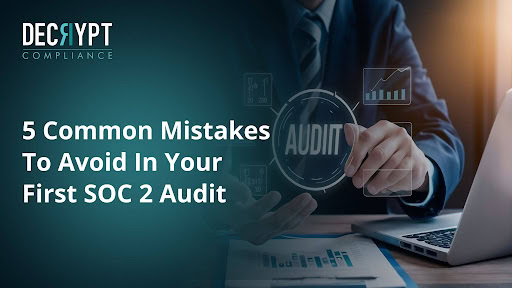
Your first SOC 2 audit is a major step for your organization, and the mistakes you make during preparation often determine whether you exit the process with a clean report or a growing list of remediation items. Many organizations underestimate the operational and documentation demands that precede formal testing.
A SOC 2 Type 1 audit reviews control design as of a stated date, so early preparation errors quickly turn into audit delays, repeated evidence requests, and buyer confidence issues. This blog identifies five common mistakes businesses make during their first SOC 2 audit, explains why each one occurs, and provides clear, actionable guidance on what to do instead.
Mistake 1: Defining Audit Scope Incorrectly
Scope defines what your auditor reviews, what customers receive, and what your internal team must support. Poor scope decisions either expand the audit to irrelevant systems or exclude systems that buyers expect to see covered.
Over-scoping often happens when organizations include development tools, test environments, or departments that never handle production customer data. Under-scoping often occurs when teams leave out secondary cloud systems, support tools, or vendors involved in handling customer data.
Your scope should begin with the service customers buy. Then connect that service to production infrastructure, identity systems, monitoring tools, data stores, support workflows, and third parties that influence service delivery.
How To Define Audit Scope Accurately
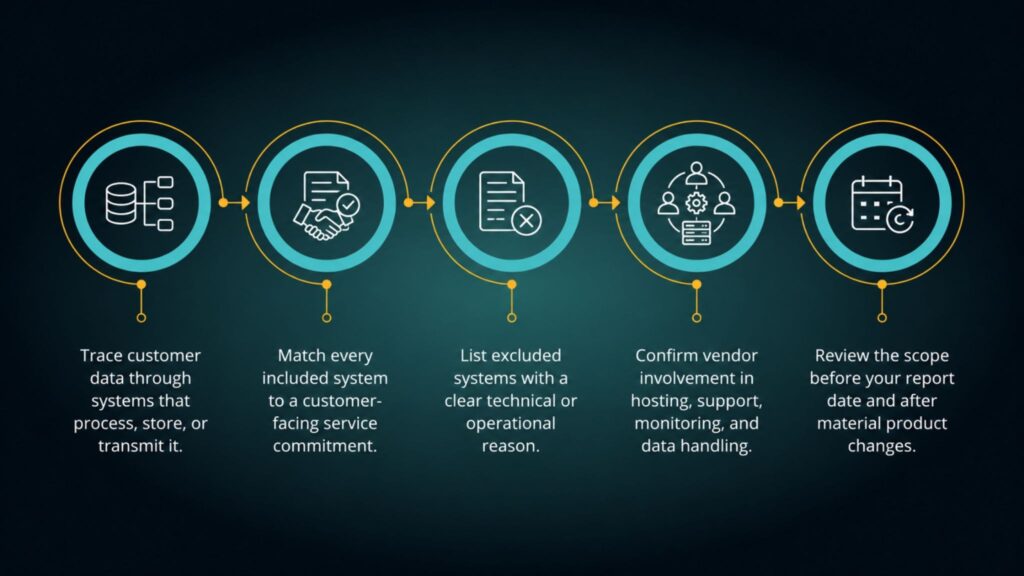
- Trace customer data through systems that process, store, or transmit it.
- Match every included system to a customer-facing service commitment.
- List excluded systems with a clear technical or operational reason.
- Confirm vendor involvement in hosting, support, monitoring, and data handling.
- Review the scope before your report date and after material product changes.
A precise scope improves the value of the final SOC 2 report. It gives customers a clear view of what the report covers, and it prevents internal teams from preparing records for systems outside the audit boundary.
Mistake 2: Delaying Readiness Until Fieldwork Is Near
Late preparation compresses policy writing, owner assignment, remediation, employee training, and internal review into an unrealistic schedule. That pressure often causes shallow controls and unresolved process defects.
Your SOC 2 readiness assessment should begin before fieldwork, as it tests whether your control environment is prepared for review. It also gives leadership a practical view of gaps that require time, budget, or cross-functional support.
First-time organizations often need several months for readiness when policies, access reviews, vendor reviews, training records, and risk documentation remain informal. The exact timeline depends on company size, service scope, selected Trust Services Criteria, and current security maturity.
How To Use Readiness Time To Close Control Gaps
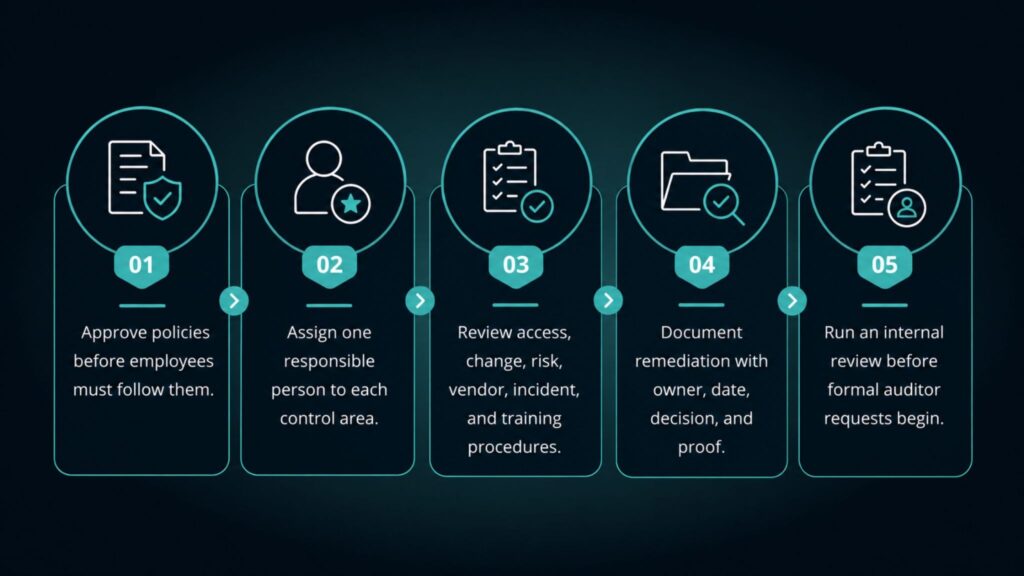
Here are the steps that you can follow to use readiness time to close control gaps:
- Approve policies before employees must follow them.
- Assign one responsible person to each control area.
- Review access, change, risk, vendor, incident, and training procedures.
- Document remediation with owner, date, decision, and proof.
- Run an internal review before formal auditor requests begin.
Readiness should not become document storage. It should confirm that your organization performs the activities described in its procedures.
Mistake 3: Collecting Evidence Without Audit Traceability
SOC 2 evidence collection fails when records lack context. A screenshot without a date, a report without a source system, or an approval without a reviewer forces your team to explain what the record proves.
Auditors review support for control activity. Common records include access approvals, termination logs, change tickets, vulnerability scan results, backup test records, vendor reviews, policy acknowledgments, risk registers, and training reports.
Late evidence creates a separate problem. Records gathered after the relevant date or period do not make up for the missing history. Your records should exist when the activity occurs, not after the auditor asks for proof.
Evidence Details Your SOC 2 Auditor Needs To Validate Controls
Evidence should be organized so every record clearly shows what it proves, when the activity happened, and who was responsible. The table below outlines the minimum details your team should capture to make the audit review faster and easier to validate.
| Evidence attribute | What your team should capture |
| Control reference | The related SOC 2 control area |
| Activity date | When the control activity occurred |
| Record owner | Who performed or approved the activity |
| Source system | Where the record originated |
| Review result | Approval, exception, remediation, or closure |
| Retention location | Folder, GRC tool, ticketing system, or repository |
Export evidence from original systems whenever possible. Source-system reports carry more review value than manually edited summaries because they preserve context and reduce questions about authenticity.
Mistake 4: Misunderstanding The SOC 2 Type 1 Audit
Many first-time organizations choose a SOC 2 Type 1 audit to meet an initial assurance need. The mistake is assuming it proves the same level of operating history as a SOC 2 Type 2 audit.
A SOC 2 Type 1 audit evaluates whether controls are suitably designed at a specific report date. A SOC 2 Type 2 audit evaluates design and operating effectiveness across a defined review period.
This distinction affects buyer expectations. Some prospects accept Type 1 during an early procurement stage, while others require Type 2 before contract execution or renewal. Your sales cycle should inform your report decision.
Questions To Answer Before Selecting A SOC 2 Report Type
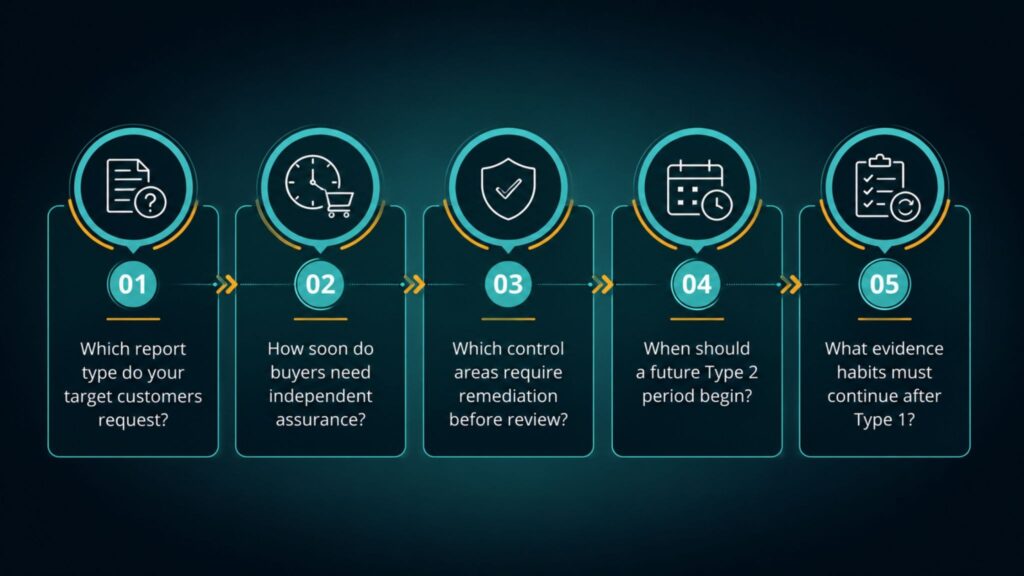
- Which report type do your target customers request?
- How soon do buyers need independent assurance?
- Which control areas require remediation before review?
- When should a future Type 2 period begin?
- What evidence habits must continue after Type 1?
Discuss these questions with a qualified SOC 2 auditor before committing to timing. The right report choice reduces wasted effort and supports a cleaner compliance path.
Mistake 5: Neglecting Employee Training And Security Awareness
SOC 2 compliance depends on employee behavior as much as documentation. Employees influence access control, credential handling, incident reporting, acceptable use, customer data protection, and policy compliance.
Weak training records often create avoidable findings. If employees have not completed training, acknowledged policies, or received incident-reporting instructions, your documentation will not align with workforce behavior.
A formal training program should include assigned curriculum, completion tracking, new-hire requirements, policy acknowledgments, and exportable reports. Training should reflect job responsibilities rather than generic security reminders.
How To Create A Compliant Training Program
A compliant training program should demonstrate that employees received security guidance, understood their responsibilities, and completed the required actions before the audit review. Your training records should also show how new hires, active employees, and relevant teams receive instruction on access rules, incident reporting, and data handling.
Here are the steps to create a complaint training program:
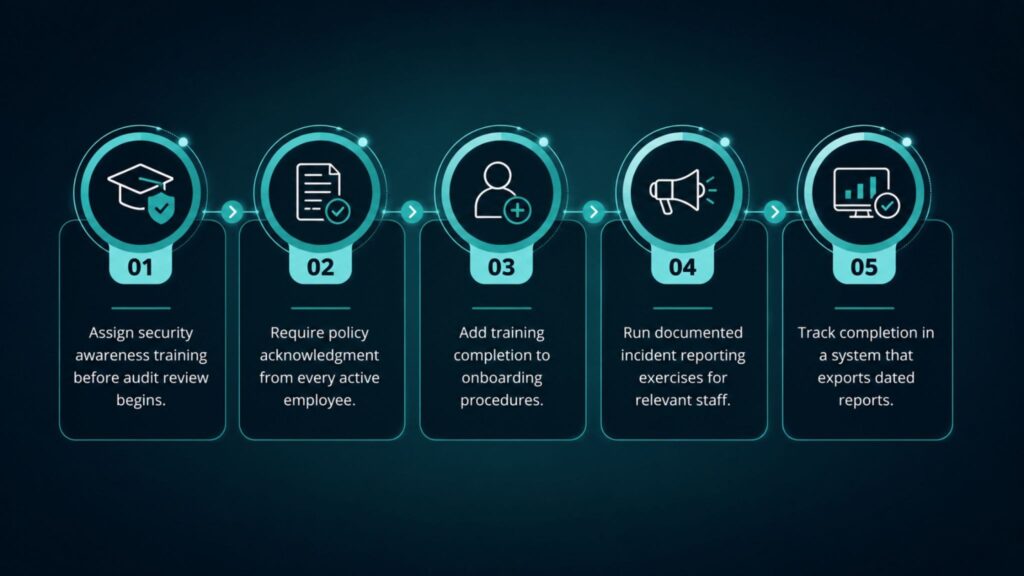
- Assign security awareness training before audit review begins.
- Require policy acknowledgment from every active employee.
- Add training completion to onboarding procedures.
- Run documented incident reporting exercises for relevant staff.
- Track completion in a system that exports dated reports.
Training also reduces operational risk outside the audit. Employees who understand escalation paths, access rules, and data handling duties make fewer preventable mistakes.
What To Know About SOC 2 Audit Cost
The cost of a SOC 2 audit depends on more than just auditor fees. Your budget should account for readiness support, formal examination fees, compliance tooling, employee time, remediation work, security testing, and documentation updates.
Report type influences cost because Type 2 requires review across a period. Additional Trust Services Criteria also increase effort because each category adds control expectations and evidence requests.
Company structure affects cost as well. Multiple products, cloud environments, vendors, regions, and teams increase preparation work. A smaller organization with one service and mature security records usually faces a simpler project.
Budget Questions To Ask Before Choosing A SOC 2 Provider
Here are some budget-related questions to ask before choosing a SOC 2 provider:
- Does the quote include readiness support or only audit review?
- Are penetration testing and vulnerability review billed separately?
- Does pricing change when more criteria are included in the scope?
- Are remediation retesting fees included?
- What internal team hours should leadership reserve?
Price comparison alone gives an incomplete picture. A cheaper audit with poor support often creates more internal work for teams already handling sales pressure, engineering priorities, and customer requests.
Avoid First-Time SOC 2 Audit Mistakes With Structured Preparation
Your first SOC 2 audit should not be slowed down by avoidable mistakes such as unclear scope, late readiness work, weak documentation, misunderstood report types, or incomplete employee training. Each issue creates extra review cycles, internal pressure, and preventable customer assurance concerns.
Decrypt Compliance helps startups and small-to-mid-sized businesses prepare for their first SOC 2 audit with structured readiness support, control documentation, evidence preparation, audit coordination, and practical guidance before fieldwork begins.
FAQs
1. How long does a first SOC 2 audit take from start to finish?
A first SOC 2 audit timeline depends on company size, scope, current documentation, selected criteria, remediation needs, and auditor availability. Organizations with mature access, vendor, risk, and training processes usually complete reviews faster.
2. What is the difference between a SOC 2 Type 1 and Type 2 audit?
A SOC 2 Type 1 audit reviews control design at one report date. A SOC 2 Type 2 audit reviews control design and operating effectiveness across a defined review period.
3. Which Trust Services Criteria should I include in my SOC 2 audit?
Security is included in every SOC 2 report. Add availability, confidentiality, processing integrity, or privacy when contracts, customer expectations, service commitments, or product features justify those categories.
4. What records should I prepare before fieldwork begins?
Prepare access approvals, user reviews, change records, vendor reviews, risk decisions, training reports, policy approvals, vulnerability records, backup test results, and incident response documentation before formal auditor requests begin.
5. Should a small company handle SOC 2 preparation internally?
A small company may manage parts of SOC 2 compliance internally when it has security, legal, HR, and engineering capacity. External support helps identify blind spots before formal review begins.