You’re probably feeling pressure to prove security fast because an enterprise buyer asked for a SOC 2 report, a deal is stuck in procurement, or renewal terms now require it.
Whether you’re leading a fast-growing startup, managing security at a lean tech team, or overseeing compliance for a B2B SaaS business, you’re under pressure to prove that your security controls don’t just exist, they work.
For small to mid-sized companies, especially those in SaaS, fintech, healthtech, or cloud-based services, SOC 2 is often the key to closing deals, unlocking enterprise partnerships, or meeting renewal terms.
So how long does a SOC 2 audit take in real life?
It depends on three things you control: your scope, how mature your controls already are, and whether you’re doing Type I or Type II. A Type I audit moves faster because it checks control design at a point in time. A Type II audit takes longer because you must run those controls for months and prove they work consistently.
This blog breaks the SOC 2 timeline into clear phases, shows what slows startups down, and gives you a realistic way to plan, so you can meet buyer expectations without turning compliance into a drag on product and engineering.
Understanding the Three Stages of a SOC 2 Audit Timeline
The SOC 2 audit occurs in three distinct phases, and each phase drives your overall timeline.
- Pre-Audit Phase
This is where you prepare your system for review. You define scope, close control gaps, document what you actually do, and start collecting evidence. For startups, this phase is often the most significant variable because it depends on how mature your controls already are.
- Audit Window Phase
If you’re doing a Type II report, you must operate your controls over a set observation period, commonly 3, 6, 9, or 12 months. During this window, you’re proving that controls don’t just exist on paper; they run consistently in real operations.
- Audit Phase
Once your controls and evidence are ready, the auditor performs fieldwork. They test control design (Type I) and operating effectiveness (Type II), review your proof, raise exceptions if needed, and then issue the final SOC 2 report.
The SOC 2 Type I Timeline for Modern Startups
If you’re going for your first SOC 2 report, Type I is the fastest entry point. It’s a point-in-time audit in which the auditor checks whether your controls are appropriately designed and in place on a specific date. They’re not testing months of operation yet, just whether your foundation is real and audit-ready. Here’s how the startup timeline works.
- Pre-Audit Phase (1-3 Months)
This phase is where most of your effort goes. Secureframe breaks it into the same core steps most first-time startups follow:
- You document your security, access, incident response, change management, and vendor practices in clear, usable policies. The goal is alignment with how your team works today.
- Establish and document procedures. Policies say what you do. Procedures show how you do it, step by step. Auditors use these to understand your control design.
- Update internal processes to align with SOC 2 requirements. You tighten gaps in day-to-day workflows: access requests, onboarding/offboarding, logging, incident handling, and change approvals. This keeps controls consistent, not ad hoc.
- Remediate technical gaps. You fix missing safeguards that auditors will flag, commonly MFA coverage, access reviews, centralized logging, vulnerability management, and vendor oversight.
- Train employees. You make sure your team understands their security responsibilities and can follow the controls you’ve defined. Evidence of training is part of readiness.
For a startup, this pre-audit phase can be short if your controls already exist, or longer if you’re building from scratch.
- Audit Phase (Around Month 4)
Once controls and documentation are in place, the Type I audit itself is relatively contained. The formal audit is a focused testing period that often lasts weeks and may extend into a couple of months, depending on the scope and evidence requests.
- Begin the Type I audit. Your CPA auditor reviews your policies, procedures, and control design. They validate that what you’ve documented is implemented in your environment.
- Receive your Type I report. After fieldwork and any minor clarifications, you receive a report stating whether the controls are suitably designed as of the audit date.
For startups, Type I is usually the “fast proof” report. It helps you show buyers you’ve built the right security baseline, even if you haven’t operated it for months yet. That’s why Type I often fits early enterprise deals, pilots, or first-time SOC 2 efforts.
The Complete SOC 2 Audit Type II Timeline for Startups
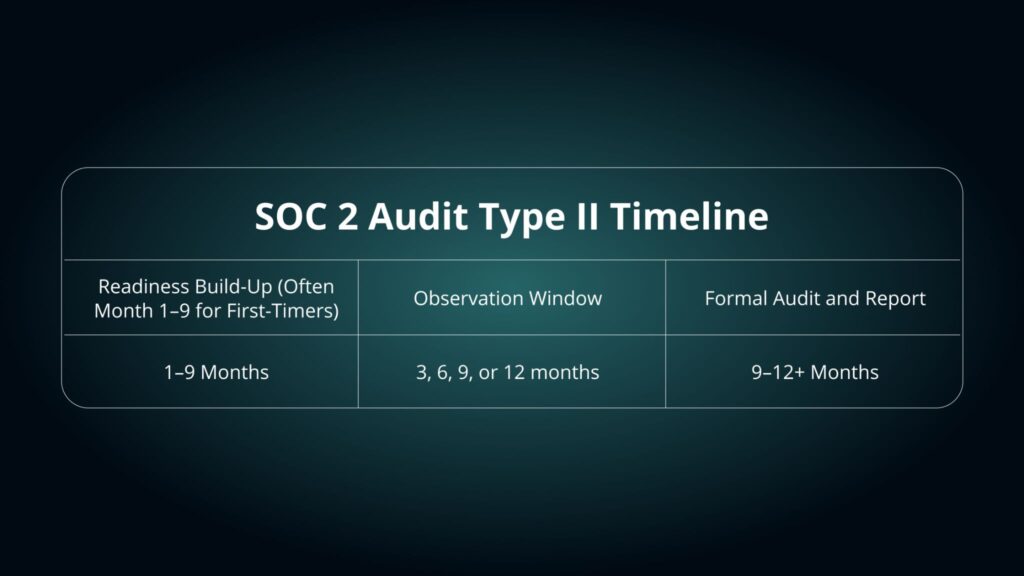
If you’re aiming for a SOC 2 Type II report, plan for a longer path than Type I. Type II doesn’t just ask, “Are your controls designed well?” It asks, “Do they keep working consistently over time?” That operating-effectiveness proof is what adds months.
- Readiness Build-Up (Often Month 1–9 for First-Timers)
This is the phase where you make your environment audit-ready before the Type II evidence clock starts. For startups, the duration depends on what’s already in place.
You usually move through these steps in order:
- Choose Type II intentionally. You confirm you need operating-effectiveness assurance (usually because buyers require sustained proof).
- Define the audit scope. You lock in the product, systems, environments, teams, and data flows that will be audited. The tighter the boundary, the faster and cleaner the audit.
- Run a gap analysis. You compare current controls to SOC 2 expectations to see what’s missing. This prevents entering a Type II window with weak controls.
- Fix technical and process gaps. You implement core controls like MFA, access reviews, centralized logging, incident response, change management, and vendor oversight. These are the controls auditors sample most heavily.
- Collect and organize documentation. Policies and procedures must match reality. Auditors will test what you do, not what you wrote you do.
- Complete a readiness assessment. This is your final check that controls are working before formal evidence collection begins.
- Observation Window
This is the part that makes Type II fundamentally longer. You operate the controls continuously for a set period, and the auditor samples evidence from across that entire window.
- Typical windows: 3, 6, 9, or 12 months.
- Many first-time startups choose 6 months, while some use 3 months to move faster.
- You need evidence for every control cycle inside that window (weekly, monthly, quarterly), not just a one-time screenshot at the end.
- Formal Audit and Report (Often Month 9–12+, Depending on Window)
Once your evidence window closes, fieldwork starts.
- The auditor tests operating effectiveness. They review samples, validate control performance across the window, and document exceptions where evidence is missing or controls didn’t run as stated.
- You close exceptions and receive the Type II report. Final issuance happens after findings are addressed and remediation proof is provided.
Enterprise buyers prefer Type II because it proves consistency. It shows your controls hold up under real operating conditions, over months, not a single date.
Type II takes longer, mainly because you must run controls long enough for an auditor to verify they work over time. If you start the window before controls are stable, timelines stretch. If you scope tightly and collect evidence continuously, timelines stay predictable.
Factors That Influence Your SOC 2 Audit Timeline
Your SOC 2 timeline isn’t random. It stretches or shrinks in response to a few predictable levers. If you understand these early, you can plan realistically and avoid delays that hit deals.
Here are the factors that matter most:
- Scope Size
The more products, environments, systems, and teams you include, the more controls you must implement and evidence you must produce. Startups slow down when they scope too broadly “just in case.” Tight, customer-driven scope keeps timelines shorter.
- Control Maturity
If your controls already run in day-to-day workflows, you’re closer to audit-ready. If you’re building controls from scratch, like access reviews, logging, incident response, or change management, expect more prep time.
- Evidence Readiness
SOC 2 is evidence-based. If you already have logs, tickets, approvals, training records, and monitoring outputs, you move faster. If evidence is missing or scattered, prep slows because you’re rebuilding history.
- Team Capacity
In a lean startup, security and IT work compete with product delivery. If there’s no clear owner or limited bandwidth, controls, and evidence collection take longer.
- Vendor and Subservice Complexity
The more third parties you rely on (cloud, payments, analytics, support tools), the more vendor due diligence and monitoring evidence you need. That adds work to both readiness and audit review.
- Audit Partner Scheduling
Even if you’re ready, your audit starts when the auditor is available. Slow response cycles or tight CPA calendars can add weeks. Booking early and staying responsive keeps fieldwork on track.
At Decrypt Compliance, we accelerate your SOC 2 journey with efficient, high-quality audits that cut your timeline in half without compromising quality.
How Does Decrypt Accelerate Audit-Ready SOC 2 Implementation?
SOC 2 compliance doesn’t have to slow down your business. Many companies face delays because they’re unsure where to start, what evidence to gather, or how to prepare for an audit without disrupting operations. Decrypt Compliance removes that uncertainty, providing clear guidance from day one and eliminating the guesswork that causes delays.
As a tech-first audit and compliance firm, we specialize in helping startups and growing teams achieve SOC 2 compliance quickly and accurately, with a deep understanding of how modern companies operate.
Decrypt Compliance keeps your certification journey smooth, efficient, and audit-ready.