If you handle customer data and can’t prove how you protect it, you’re a risk, not a vendor.
In today’s environment, security is not assumed. It’s verified. And SOC 2 is how clients verify whether your controls actually work.
Clients are asking more complex questions. Vendor assessments are stricter. Security questionnaires are longer.
63% of tech buyers say they prioritize SOC 2 reports when selecting a vendor. Nearly 80% of procurement teams now include SOC 2 as part of their vendor onboarding process. If your business isn’t already SOC 2 compliant or preparing to become so, you’ll start losing deals, especially in industries such as SaaS, fintech, healthcare, and enterprise services.
This is no longer optional for companies that want to grow, retain trust, or handle sensitive data responsibly. This blog breaks down what you need to know about SOC 2 compliance requirements that every business must meet, and why working with the right partner can change the entire audit process.
| Article Summary SOC 2 ensures your business meets strict standards for data security, privacy, and availability. Type I evaluates control design; Type II tests effectiveness over time. SOC 2 covers five Trust Services Criteria: Security, Availability, Processing Integrity, Confidentiality, and Privacy. Proper documentation and evidence are crucial for a successful SOC 2 audit. The right SOC 2 auditor streamlines the process and reduces risks. |
The Importance of SOC 2 Compliance for Managing Customer Data
If your company handles customer data, especially in cloud-based services, your clients expect proof that their information is safe. SOC 2 provides a structured approach to demonstrating this.
SOC 2 (Service Organization Control 2) is a compliance framework created by the American Institute of Certified Public Accountants (AICPA). It’s used to evaluate how well a service organization protects customer data based on specific trust criteria.
It focuses on internal controls, not just policies on paper, but how your team actually manages systems, users, and risks on a day-to-day basis.
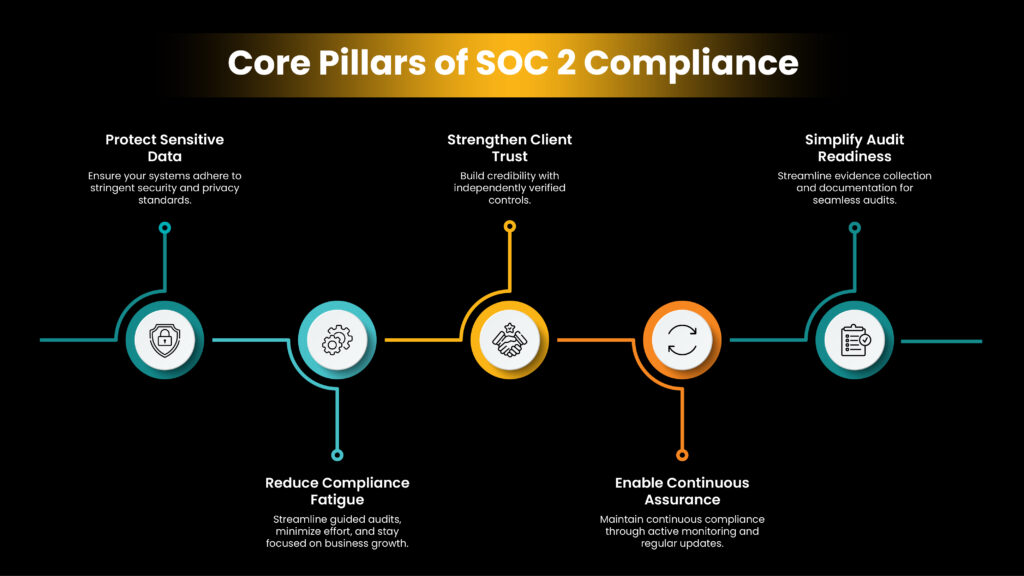
SOC 2 helps your business prove it can be trusted with sensitive information. It tests your controls across five key areas called Trust Services Criteria (TSC):
- Security (required)
- Availability
- Processing Integrity
- Confidentiality
- Privacy
Not all five are mandatory, but security is always compulsory. The rest depend on your services and customer expectations.
SOC 2 Report Types
You need to know the difference; it affects your timeline, cost, and depth of review.
| SOC 2 Type | Description | What It Answers | Usage |
| Type I | Assesses whether your controls are appropriately designed at a single point in time. | “Do the right policies and systems exist right now?” | Often used as a starting point or for early-stage companies. |
| Type II | Tests whether those controls actually work over a defined period (usually 3–12 months). | “Are those policies followed consistently in real operations?” | Required by most enterprise customers and procurement teams. |
How SOC 2 Uses the Trust Services Criteria to Measure Data Protection?
To meet SOC 2 compliance, you must demonstrate how you manage customer data in a secure, reliable, and privacy-respecting manner. This is measured against five Trust Services Criteria (TSC).
Each TSC represents a different risk area. Getting this right helps reduce legal exposure, improve client trust, and align your operations with enterprise expectations.
- Security
This is the foundation of every SOC 2 audit. It measures whether your systems are protected against unauthorized access, data breaches, and misuse.
- Access Control: Who can access your systems, and under what conditions? You need strict user provisioning, role-based permissions, and regular audits to prevent privilege creep.
- Multi-Factor Authentication (MFA): Passwords aren’t enough. MFA adds a second layer, such as a code or app approval, to block unauthorized logins, especially for critical systems and administrative accounts.
- Intrusion Detection: You must monitor for suspicious activity, failed login attempts, or known attack patterns. A solid IDS or SIEM solution is expected.
- Endpoint Protection: Devices (such as laptops, servers, and phones) must be secured with antivirus, patch management, and endpoint management tools. Unmanaged endpoints are a common attack vector.
- Availability
Focuses on whether your systems are reliable and accessible when customers need them. This is critical if you offer uptime guarantees or handle real-time data.
- System Monitoring: Continuous monitoring tools should track uptime, errors, latency, and usage patterns to provide a comprehensive view of system performance. Alerts must trigger when thresholds are breached.
- Performance Metrics: Define and monitor SLAs and KPIs for infrastructure, applications, and services. This helps detect slowdowns or bottlenecks early.
- Disaster Recovery Planning: You need a documented, tested plan to restore services during outages, cyberattacks, or hardware failures. Downtime costs money and reputation.
- Processing Integrity
Applies if your system processes transactions, performs calculations, or transforms data. The goal is to ensure that what goes in matches what comes out, without errors or tampering.
- Accuracy and Completeness of Data Processing: Systems must handle input correctly and produce valid outputs. Controls, such as validation checks and reconciliation processes, are expected.
- Quality Assurance Procedures: Testing environments, peer code reviews, and deployment gates help prevent flawed updates from reaching production.
- Confidentiality
This applies when you store or handle confidential business data, such as contracts, customer lists, or proprietary algorithms.
- Data Encryption (in Transit and at Rest): You must encrypt sensitive data both when it moves across networks and when it’s stored. TLS and AES-256 are common standards.
- Information Classification: Not all data is equal. You need policies to classify information based on sensitivity and apply protections accordingly.
- Role-Based Access: Access to confidential data should be limited to those who need it. Enforce the principle of least privilege and regularly review permissions.
- Privacy
Use this if you collect personal data, such as emails, names, IP addresses, or any other information that identifies an individual. It aligns with laws like GDPR and CCPA.
- Personal Data Collection, Usage, Retention, and Disposal: Define what data you collect, why, how long you keep it, and how you dispose of it. The less you store, the lower your risk.
- User Consent and Data Subject Rights: Users must be aware of the data you collect and provide explicit consent. They should also be able to request access to, correction of, or deletion of their data.
SOC 2 Compliance Requirements Every Business Must Meet
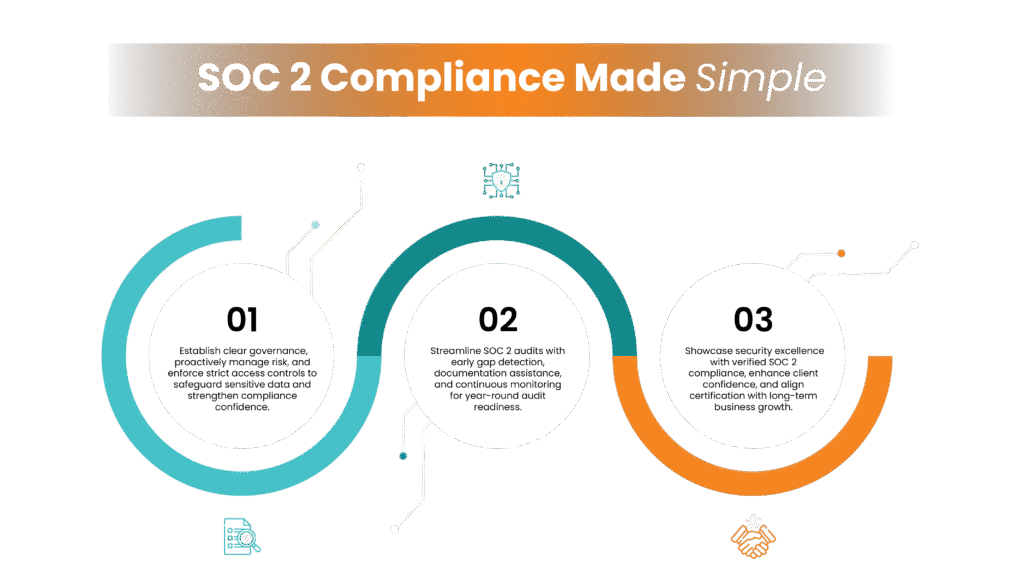
SOC 2 compliance isn’t just about having policies; it’s about proving your systems and processes actually enforce them. These are the operational and technical areas auditors will evaluate. If any of these are weak or undocumented, you’ll fail the audit or need costly remediation.
This section outlines what you need to have in place and how each area directly relates to trust, security, and service reliability.
- Governance and Risk Management
Your foundation. If your company doesn’t govern risk, security becomes reactive instead of planned. You need written, up-to-date policies that cover data handling, access, change management, and other relevant areas of concern. These must be reviewed annually and accessible to staff.
You’re expected to regularly identify, evaluate, and document internal and external risks. This includes threat modeling, control reviews, and mitigation planning. Third-party providers must be evaluated for security risks. Maintain a list of vendors, assess their controls, and ensure contracts include data protection terms.
- Access Controls
Mismanaged access is one of the most common failure points in audits and breaches.
Grant access based on job roles, not convenience. When employees leave or change roles, access must be removed or adjusted immediately.
Users should only have access to the data and systems they need, nothing more. This limits the damage if an account is compromised. MFA must be enabled for all critical systems, especially admin and remote access accounts. Password-only access is no longer sufficient.
- Incident Response
You will have incidents, and SOC 2 requires you to show how you’ll respond. A step-by-step guide for identifying, containing, and resolving security incidents. It must include communication protocols and escalation paths.
Everyone involved in incident response should be aware of their role in advance. This avoids delays when minutes count.
After an incident, you must document what happened, how it was handled, and what changes will be made to prevent a repeat. Auditors will ask to see these reports.
- Change Management
Changes to systems, code, or infrastructure must be controlled. Untracked changes lead to outages and security gaps. Every change, whether a patch, deployment, or configuration, must be logged with an apparent reason and scope.
No code or system update should be deployed without thorough testing and sign-off. This reduces the chance of introducing bugs or vulnerabilities. Use a versioning system to track changes to code and configs. It supports rollback in case a change causes problems and displays your change history to auditors.
- System Operations and Monitoring
SOC 2 requires proof that you actively monitor and manage your systems, not just when something breaks. System and security events should be logged continuously. Logs should include access events, errors, and system actions, and then be stored securely.
You must have automated alerts for activities like failed logins, privilege escalation, or file tampering. Manual detection isn’t enough. Conduct internal audits and periodic reviews of system health, logs, and security settings. Document findings and corrective actions.
- Data Encryption and Protection
Encryption is a baseline requirement. If you’re not encrypting sensitive data, you’re failing modern compliance standards. All data moving across networks must be protected using Transport Layer Security (TLS). Plain HTTP or unencrypted APIs are unacceptable.
Store data using strong encryption, such as AES-256. This includes databases, backups, and any file storage systems. Define who manages encryption keys, how keys are stored, rotated, and revoked. Poor key management can undermine even the strongest encryption.
Why the Right SOC 2 Auditor Makes a Difference in Your Compliance Process?
A SOC 2 auditor is a licensed, independent CPA or firm authorized to perform SOC audits under the AICPA framework. Their job is to review your systems, processes, and controls and determine whether you meet the SOC 2 criteria.
This includes:
- Evaluating your internal controls related to security, availability, confidentiality, etc.
- Reviewing documentation, system logs, policies, and processes.
- Testing the effectiveness of controls (especially for Type II audits).
- Issuing the final SOC 2 report, which clients, partners, and stakeholders use to verify your compliance.
Auditors don’t just verify if policies exist; they look at how consistently your team applies them in day-to-day operations.
Choosing the wrong auditor can result in significant costs, including time, money, and lost trust. An auditor unfamiliar with your industry or technology stack may ask irrelevant questions or overlook key risks. This often leads to delays, frustration, or worse, missed gaps that affect your audit outcome. An experienced SOC 2 auditor who understands your environment can:
- Ask the right questions from the start.
- Interpret controls in the context of your actual operations.
- Help reduce “audit fatigue” by focusing only on what’s relevant.
- Make certification renewals smoother by identifying long-term process improvements.
A SOC 2 audit is only as good as the team performing it. At Decrypt Compliance, we’ve redefined the audit process to deliver faster results without compromising quality.
Simplify Your SOC 2 Audit with Decrypt Compliance’s Strategic Approach
SOC 2 audits can be challenging to manage, with each audit requiring specific controls, documentation, and timelines.
Whether you’re preparing for your SOC 2 audit or working on a renewal, the process can quickly drain time and resources if not handled strategically.
That’s where Decrypt Compliance makes the difference. As your independent audit and compliance partner, we help you:
- Streamline SOC 2, ISO 27001, ISO 27701, and ISO 42001 certifications under one coordinated process.
- Identify gaps early and cut through the administrative overhead that slows audits down.
- Align compliance goals with real business value, ensuring your certification supports growth, not just compliance.
- Move quickly with expert guidance that combines technical accuracy with business practicality.
Whether you’re establishing compliance for the first time or renewing multiple frameworks, we ensure you stay audit-ready throughout the year.